

Blog
Modelling Preauthorization Part II
Modelling a Solution
Read Time: 3 Minutes
As discussed previously in Part I, preauthorization in practice has proven to be a challenging problem to solve. The mandate from the Centers for Medicare and Medicaid Services (CMS-0057-F) is an attempt to address these issues and has several goals:
Improve the exchange of data and communications through the use of interoperability.
Enhance patient access to health information.
Reduce administrative burdens.
Improve coordination among providers.
It specifies several application programming interfaces (APIs) to enhance the exchange of data between various groups.
While this is a step in the right direction, implementing it will be difficult. Both the sheer magnitude of the issues involved, and the costs required to develop a solution boggle the mind. This is not something that can be taken lightly.
Modeling the solution
When starting any project, you need a good plan, the right tools, and adequate resources.
My wish list for the software environment to use for such a project includes:
can integrate with FHIR
can integrate with the various EHRs
can integrate with the required APIs
provides adequate security and confidentiality
understands the semantics of medicine and the various coding systems
provides a low code programming environment that is easy to understand and maintain
able to provide a front-end to legacy system where needed
able to orchestrate all of the above
If you look at the software standards encompassed by BPM+ Health, then most of these wishes can be fulfilled:
KEM (Knowledge Entity Modeling): provides semantic understanding
SDMN (Shared Data Modeling and Notation): enhances FHIR integration
Other standardized software tools such as CDS Hooks and SMART on FHIR can provide services to complete the toolbox.
Importance of Orchestration
The ability to orchestrate all of the interacting pieces is essential to comply with the CMS metrics. As shown in Figure 1, there are many stakeholders who need to work together.
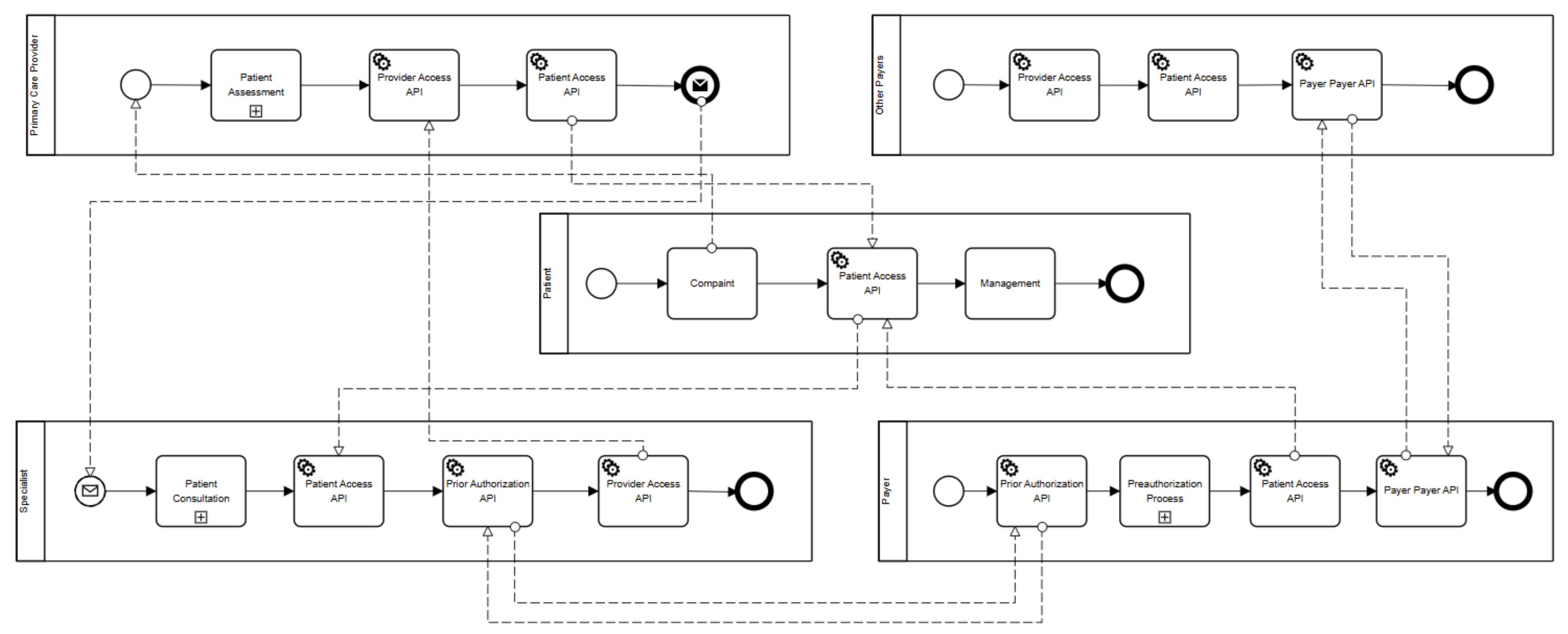
While this is an oversimplification intended for illustration purposes only, it highlights how important coordination is. To achieve the goals specified by CMS we have to rely on others. Only by working together will we achieve success.
What's Next?
While compliance to the CMS mandate is being phased in gradually, solving this problem will be complex. It may overwhelm some legacy systems or drive more consolidation. Even a system that gets by initially may not be able to keep up with future demands. Although this is all a bit scary, it is an opportunity to make healthcare better.

























































































































Learn how it works
Request DemoConfirm your budget
Request PricingDiscuss your project
Request Meeting