
Blog
The Missing Counterpart to the UBO (Ultimate Beneficial Owner)
Why Every AI Decision Needs an Ultimate Decision Owner (UDO)
Read Time: 5 Minutes
Corporate governance solved one of its biggest transparency problems years ago. Companies had become extraordinarily good at hiding who really owned them.
Layer upon layer of holding companies, trusts, nominee shareholders, and offshore entities made it increasingly difficult for regulators to answer a deceptively simple question:
Who ultimately benefits from this company?
The answer was the Ultimate Beneficial Owner (UBO).
The UBO principle transformed financial governance because it established a non-negotiable rule: every ownership structure must ultimately terminate at a real human being. Regardless of how complex the legal construction becomes, someone ultimately owns the economic benefits.
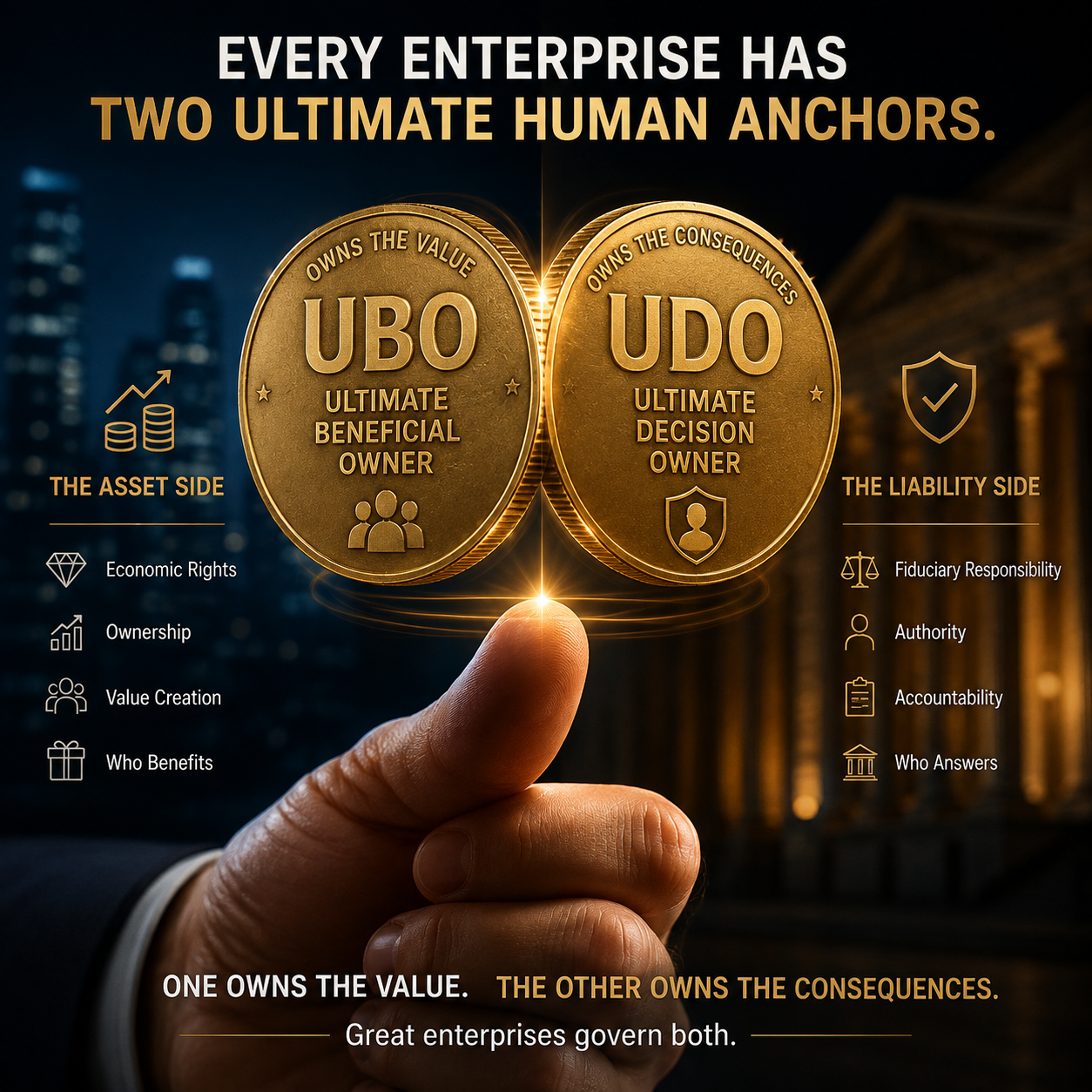
As enterprises enter the age of AI, we are encountering a remarkably similar governance problem—but this time it is not about beneficial ownership.
It is about decisions.
The Other Side of the Balance Sheet
The UBO represents the asset side of enterprise governance.
It identifies who ultimately enjoys the rights, benefits, and value created by the organization. But every balance sheet has another side. Liabilities represent obligations, responsibilities, and commitments.
As AI becomes increasingly capable of recommending, executing, negotiating, and even making decisions, organizations need an equivalent governance principle for the liability side of the enterprise.
Not an Ultimate Beneficial Owner. An Ultimate Decision Owner (UDO).
If the UBO answers the question:
“Who ultimately benefits?”
The UDO answers the equally important question:
“Who ultimately answers?”
AI Is Creating Decision Assets—and Decision Liabilities
For decades, organizations have invested in technology to increase productivity and create enterprise value. Artificial intelligence accelerates that trend dramatically.
It is about decisions.
- AI assistants improve knowledge work.
- AI performers execute operational tasks.
- AI agents pursue goals with delegated authority.
- AI orchestrators dynamically coordinate people, processes, and systems.
Each step creates more value for the enterprise. But every increase in delegated autonomy also creates additional governance exposure.
Every consequential decision creates not only business value but also accountability.
Every automated approval, every autonomous transaction, every AI-generated recommendation accepted by the business creates what might be called a decision liability—an obligation to explain, justify, defend, and, if necessary, accept responsibility for the outcome.
Unlike financial liabilities, these obligations rarely appear on a balance sheet. Yet regulators, customers, shareholders, and courts increasingly expect organizations to demonstrate exactly who is responsible.
The New Governance Question
For years, governance focused on AI models.
- Which model produced the output?
- How accurate is it?
- Can we explain how it arrived at its recommendation?
These remain important questions, but they are no longer sufficient. Risk does not materialize inside a neural network. Risk materializes when an organization makes a decision.
That is why governance must move from being model-centric to decision-centric. The natural unit of governance is no longer the AI model—it is the business decision itself. But once governance moves to the decision, another question immediately follows:
Who ultimately owns that decision?
Introducing the Ultimate Decision Owner (UDO)
The Ultimate Decision Owner is the human being who ultimately owns the authority, accountability, and consequences of every consequential decision, regardless of how much of the operational work is delegated to AI.
- The AI may recommend.
- The AI may execute.
- The AI may coordinate.
- The AI may even decide within explicitly delegated authority.
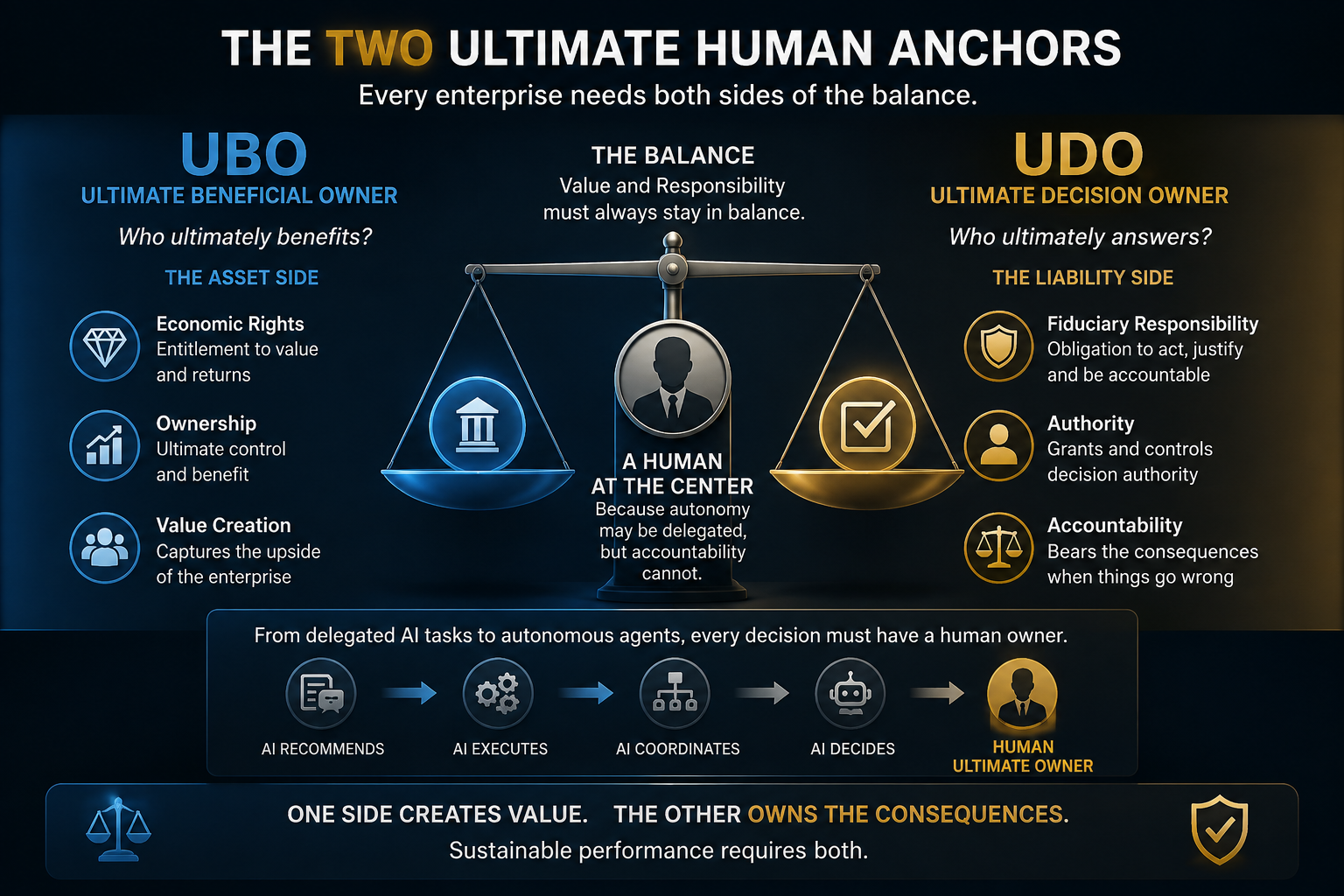
But accountability must always terminate with an identifiable human. Not because that individual clicked the final approval button. But because they own the governance framework that granted the AI its authority in the first place.
Just as every ownership chain ultimately leads to a UBO, every decision chain should ultimately lead to a UDO.
Completing the Governance Balance Sheet
The UBO and the UDO together provide a simple but powerful governance framework.
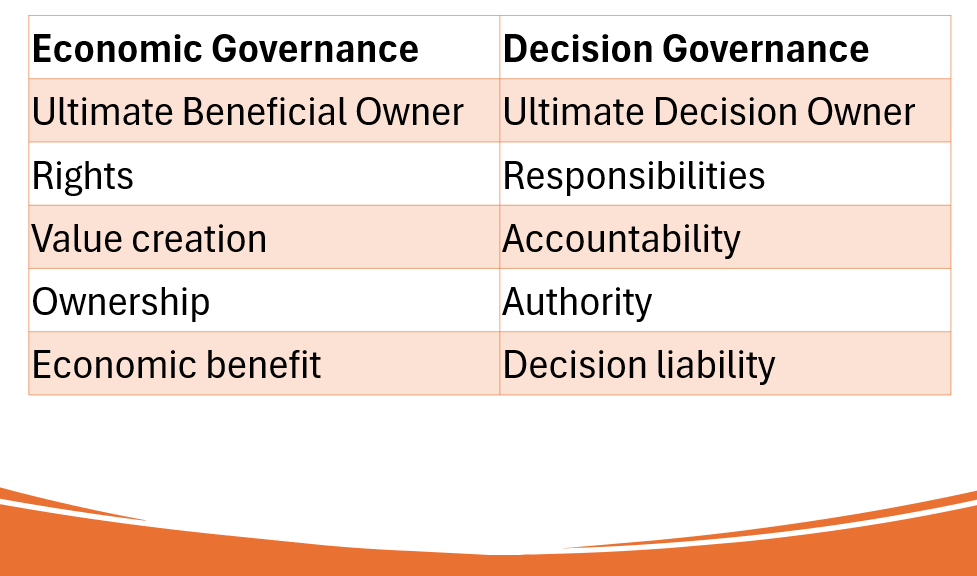
One explains where value ultimately flows. The other explains where responsibility ultimately resides. Together, they establish the two human anchors every enterprise needs in the age of AI.
- One for assets.
- One for liabilities.
- One for value.
- One for accountability.
The Boardroom Question
Boards rarely ask whether a large language model generated a recommendation.
They ask something much simpler.
Who approved this?
Increasingly, regulators will ask a related question.
Who ultimately owns this decision?
Organizations that answer that question quickly, consistently, and transparently will earn trust. Those that cannot will discover that AI’s greatest challenge was never technological. It was always governance.
Just as financial transparency required the invention of the Ultimate Beneficial Owner, AI governance may require its natural counterpart:
The Ultimate Decision Owner.
Because while AI can be delegated authority, accountability must always remain human.
Follow Stefaan Lambrecht on his website.


















































Learn how it works
Request DemoConfirm your budget
Request PricingDiscuss your project
Request Meeting